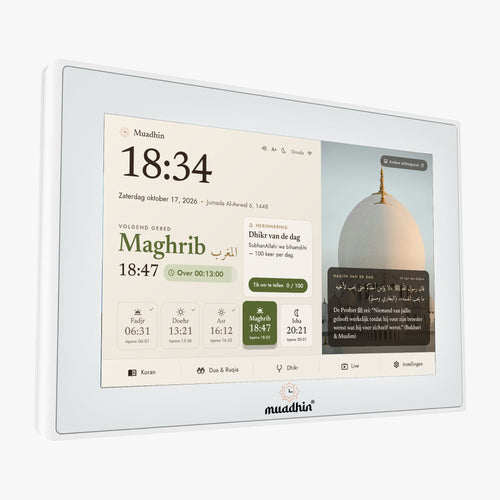
Have you ever wondered why the prayer times in your app are slightly different from those of your mosque? That is not a mistake. Prayer times are calculated based on the position of the sun, and there are different methods for this. In this article we explain how it works and why it is extra complicated in the Netherlands.
The five prayers and the position of the sun
- Fajr: begins at dawn, when the first light appears on the horizon.
- Dhuhr: just after the sun has reached its highest point.
- Asr: in the afternoon, when the shadow of an object has reached a certain length.
- Maghrib: right after sunset.
- Isha: when the evening twilight has disappeared.
Dhuhr and Maghrib are easy to determine. For Fajr, Asr and Isha, the methods differ.
Fajr and Isha: which angle do you use?
Fajr and Isha are calculated using the angle of the sun below the horizon. Different organisations use different angles, for example:
- Muslim World League: Fajr 18°, Isha 17°.
- ISNA (North America): Fajr and Isha 15°.
- Egyptian method: Fajr 19.5°, Isha 17.5°.
- Umm al-Qura (Makkah): Fajr 18.5°, Isha a fixed number of minutes after Maghrib.
The larger the angle, the earlier Fajr and the later Isha. In the Netherlands the difference can add up to half an hour or more.
Asr: Shafi'i or Hanafi
According to most schools of law (Shafi'i, Maliki, Hanbali), Asr begins when the shadow of an object is as long as the object itself, plus the shadow at noon. According to the Hanafi school, it is twice the length. As a result, Asr falls later with the Hanafi method. Many Turkish mosques follow the Hanafi method, while Moroccan mosques usually follow the Maliki method.
Why it is extra difficult in the Netherlands
The Netherlands lies far to the north, around 52 degrees. In summer the sun does not sink deep enough below the horizon at night: it never gets completely dark. With an angle of 18°, there is then simply no Fajr or Isha time according to the calculation.
That is why mosques and apps use adjustments for high latitudes in summer, such as:
- Middle of the night: the night between Maghrib and sunrise is divided in two.
- One-seventh of the night: Isha begins after the first seventh of the night, Fajr in the last seventh.
- Angle-based division: a portion of the night that depends on the chosen angle.
- A smaller angle, for example 12° or 13°, which many mosques in Europe use.
Each mosque makes its own choice in this, often in consultation with the imam. That is why times differ from mosque to mosque, sometimes even within the same city.
Which times should you follow?
The advice of most imams is simple: follow the times of your own mosque. That way you pray at home at the same moment as the community, and you don't have to choose between methods yourself. In doubt? Ask the imam of your mosque.
Prayer times automatically, or those of your mosque
The Muadhin adhan clock automatically fetches the prayer times for your location via Wi-Fi. Would you rather follow the times of your own mosque? You can easily set them yourself. The adhan then sounds automatically at every prayer time, audible for the whole family.